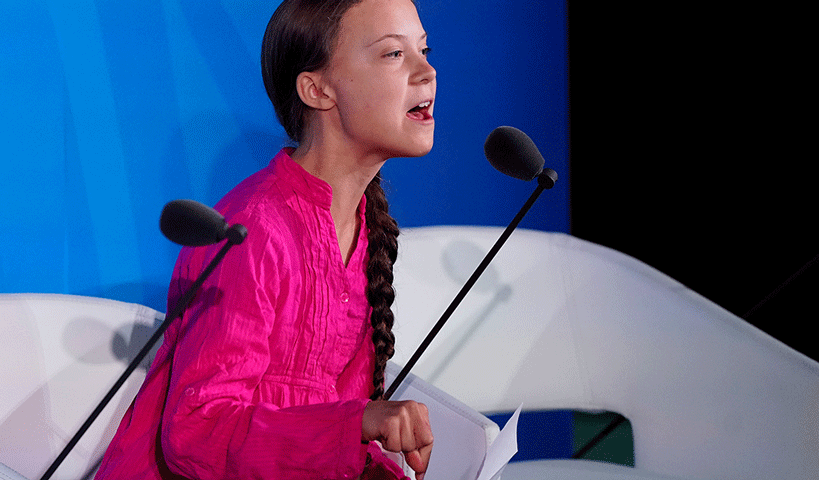
If you’ve been following the media at all lately, then you’ve definitely heard about 16 year old Swedish climate activist Greta Thunberg. On September 23rd 2019, Greta spoke at the UN Climate Action Summit and shamed world leaders for their lack of urgency and action when it comes to our climate crisis—and rightfully so.
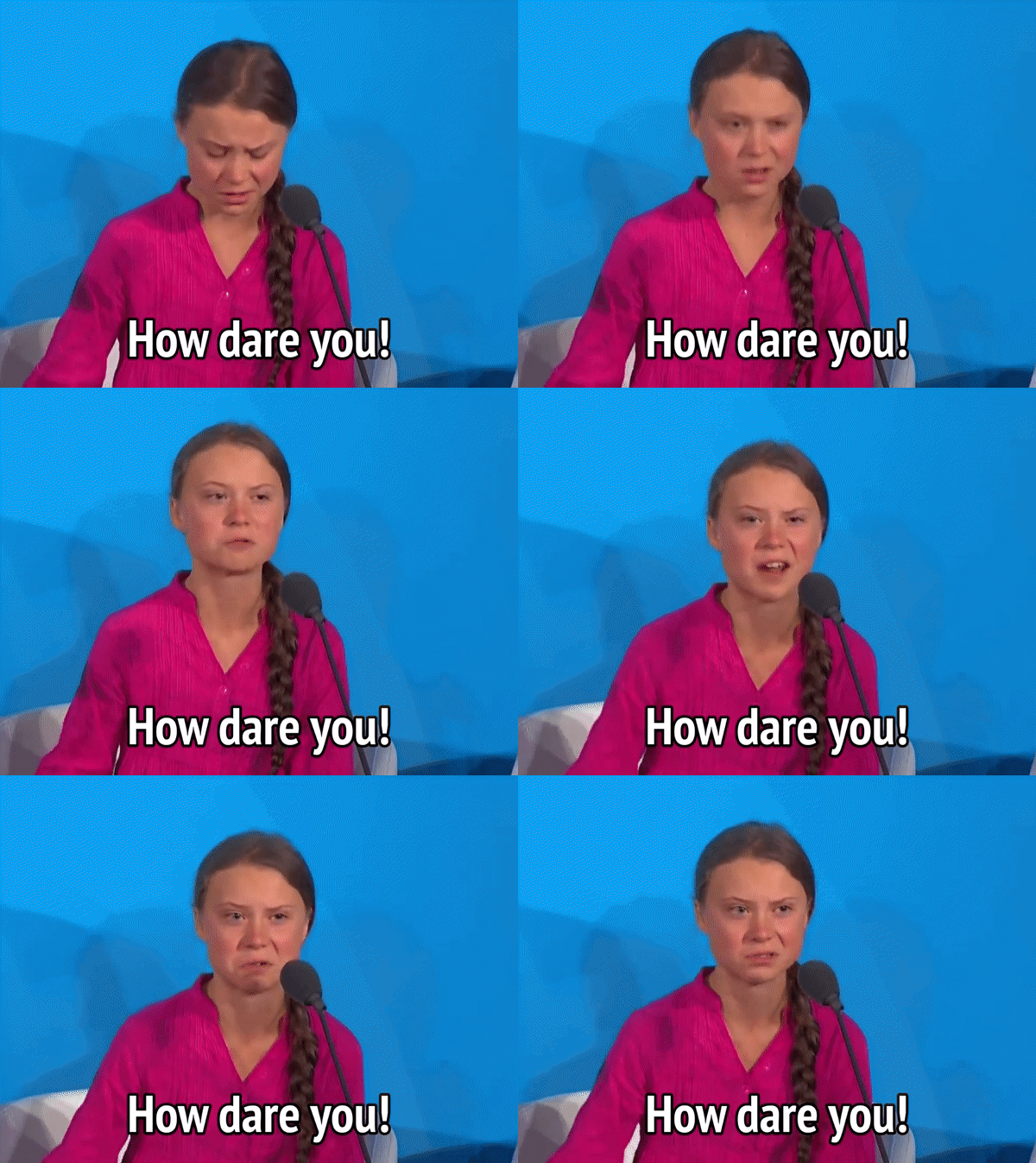
She opens her speech acknowledging the fact that she’s not happy to be there. Rather, she expresses her disappointment that leaders have turned to her ‘for hope’. “How dare you”, she blames. Her speech is chalk full of scientific truths to prove her claims, stating that young people are beginning to realize this betrayal and will not be forgiving. It’s public knowledge that Greta has Asperger’s (a syndrome on the autism spectrum), and at the end of her speech, she refers to it by saying “it’s hard to be the center of attention; I don’t like that. I have to tell myself it’s for a good cause”.
“We are in the beginning of a mass extinction. And all you can talk about is money and fairytales of eternal economic growth. How dare you!”
— Greta Thunberg
So there I am, using my reusable stainless steel straw feeling good about myself while reading about Greta on Twitter, and automatically feel shame. Here is this sixteen year old girl who legitimately has a condition that makes it more difficult than usual to speak in front of large crowds, and she’s at the United Nations telling these leaders what’s what. My first thought is obviously that I need to do better, and secondly, that I’m so proud of her. She’s brave, selfless, confident, intelligent and quite frankly, a bada**. But while she is all those things, she’s still a child. When did it become okay to let children worry about the state of the planet? When did it become okay for children to calculate the CO2 budget not for science class, but for survival? When did it become acceptable for children to participate in the global public sphere?
This train of thought brought me back to our discussions in week 2, specifically surrounding Charles Taylor’s understanding of the public and private sphere, and his commentary on Habermas’ ideologies. To boil down Habermas’ explanation to its simplest terms, those allowed to participate in the public sphere (obviously in the context of Western Europe in the 1800s pre-industrialism) were white bourgeoisie middle class males, and it was their right to discuss matters of politics in a space outside of the government. Charles Taylor building off of Habermas’ explanation, explains that to be part of the public sphere is to live ‘the good life’, and also says the public sphere is an essential feature of a free society.
Obviously, the way we understand public and private spheres and their precedents in 2019 has changed. I’d like to take the aforementioned points and apply them to Greta’s case. We’ve moved on from having public spheres dominated by the white cis male (debatable) and are more open minded as a society. So much so that we’ve romanticized the idea of a young child leading the world, before even questioning if it’s ethical. In Greta’s case, is she living ‘the good life’? If children are worried for their well being, is it really a free society?
I’d like to pull on Charles Baudelaire’s writing, specifically his explanation on the new modern man: the flâneur. By loose definition, a flâneur is someone who maintains a certain status or life position where they are able to observe the world freely without worry; a ‘lounger’. In my opinion, children are (or should be) in the role of a flâneur; free to learn from, observe, challenge, and question the world without worry or consequence. In Greta’s case, this privilege has been taken from her. Not only does she take on responsibility of the Earth’s well being, her presence in the public global sphere (inclusive of the internet, which in itself is a wide open public sphere giving anyone a voice) leaves her exposed to the critiques of adults, those of which are not always pleasant (shockingly, some men are pissed).
It’s no secret that Greta isn’t the only child to have this privilege taken from her, and in most scenarios the details are more extreme. Greta is no stranger to this fact, and takes a moment to acknowledge her privilege as paraphrased in the above left tweet.
Especially in 2019, as long as we have those who put themselves forward for the betterment of humanity—regardless of demographic—there will be thousands more ready to both praise and critique. As a society we need to do better so that children don’t feel the need to take control of adult responsibilities. I leave you with the video below. Despite my argument, there’s no denying Greta’s bravery and light.
Charles Taylor, “Chapter 7: Public and Private”. Modern Social Imaginaries. Duke University Press, 2004. 102.
Charles Baudelaire, “The Artist, Man of the World, Man of the Crowd and Child,” (1863) in The Painter of Modern Life and Other Essays, Vol 2. Ed and trans. by Jonathan Mayne. London: Phaidon Press, 1995: 6-7.
 FILM 3610G - CINEMATIC PUBLICS & PARTICIPATIONS: MOVEMENTS, MANIFESTOS, FILM FESTIVALS, COLLECTIVES